Electrical Engineering Circuit Theorems & 2nd Order Circuits
عدد الدروس : 37 عدد ساعات الدورة : 03:19:27 شهادة معتمدة : نعم التسجيل في الدورة للحصول على شهادةللحصول على شهادة
- 1- التسجيل
- 2- مشاهدة الكورس كاملا
- 3- متابعة نسبة اكتمال الكورس تدريجيا
- 4- بعد الانتهاء تظهر الشهادة في الملف الشخصي الخاص بك
قائمة الدروس
عن الدورة
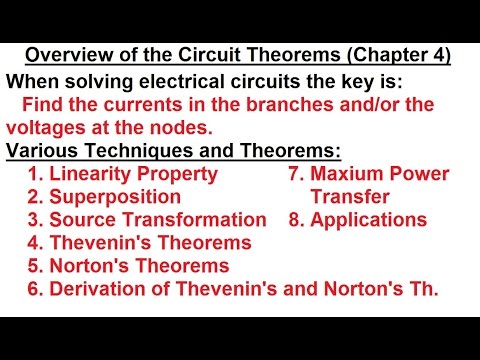
This course delves into fundamental electrical engineering circuit theorems and the analysis of 2nd order circuits. Starting with the linearity property, learners explore how circuits respond proportionally to input sources, followed by the superposition theorem, which allows simplifying multi-source circuits. The series continues with source transformation techniques, enabling seamless conversion between voltage and current sources for easier analysis.
Students then learn Thevenin’s and Norton’s theorems, powerful tools for reducing complex networks to simple equivalent circuits, along with practical examples and derivations. The maximum power transfer theorem teaches how to design circuits for optimal power delivery. Concepts like source modeling, resistance measurement, and Wheatstone bridge analysis are also thoroughly explained, making real-world applications tangible.
The series concludes with an introduction to 2nd order circuits, laying the groundwork for understanding RLC networks and their transient and steady-state responses. Throughout the course, each theorem and method is paired with practical examples, step-by-step derivations, and problem-solving techniques, ensuring that learners gain not only theoretical knowledge but also practical analytical skills essential for electrical engineering.
By the end of the course, students will be able to analyze, simplify, and optimize electrical circuits efficiently, setting a solid foundation for advanced electrical engineering studies.


